Single vision, bifocal, or progressive — which lens is right for you?
Not all prescription lenses are created equal. Here’s everything you need to know before your next eye appointment.
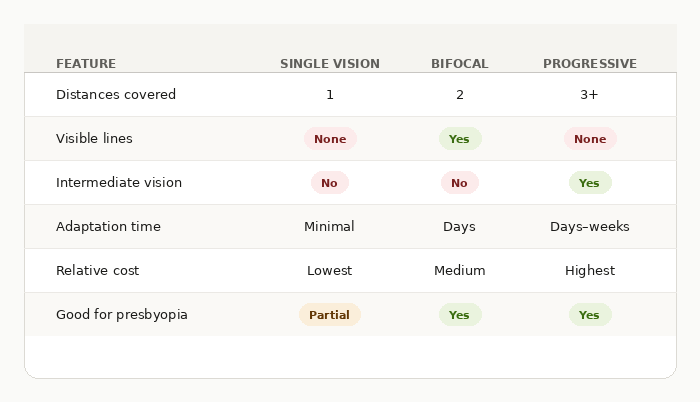
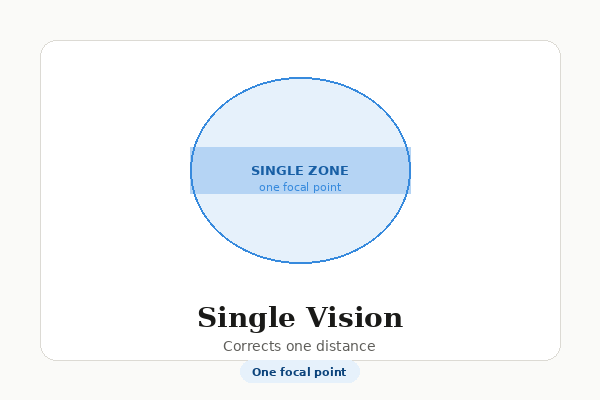
Single vision lenses are the most straightforward of the three. They correct vision at exactly one distance, either far away (for nearsightedness), up close (for reading glasses), or somewhere in between. The entire lens has a uniform prescription, meaning wherever you look through the lens, you get the same correction.
These are typically the first type of lens people are prescribed, and they’re ideal for children, teenagers, and younger adults whose vision needs fall cleanly into one category.
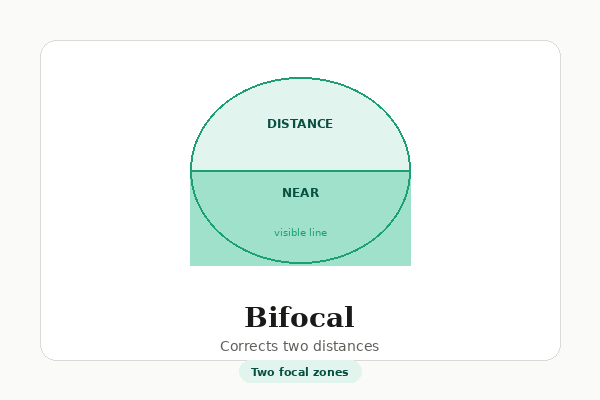
Bifocal lenses were invented by Benjamin Franklin in the 18th century to solve a real problem: what do you do when you need correction at both distance and near? His solution was elegantly simple put two distinct lens prescriptions into one frame, separated by a visible horizontal line.
The upper portion of a bifocal lens handles distance vision, while the lower segment (usually a distinct D-shaped or round insert) handles close-up work like reading. There’s no in-between, you’re either looking through one zone or the other, and the transition is abrupt.
Bifocals are most commonly prescribed when presbyopia sets in, typically around age 40–45, when the eye’s lens loses its ability to flex between near and far focal lengths.
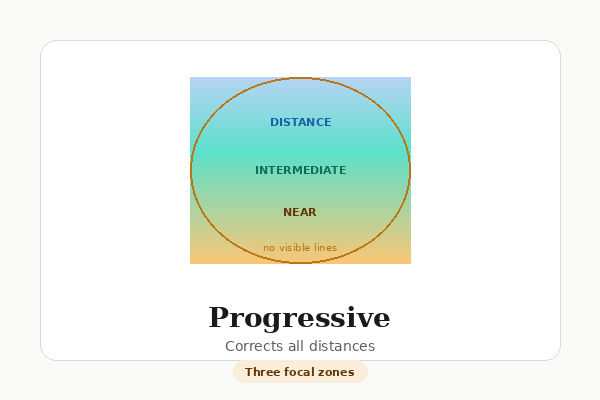
Progressive lenses are the modern, no-line evolution of bifocals and they’re significantly more sophisticated. Rather than two distinct zones, progressives offer a seamless gradient of focal power from top to bottom. You look up for distance, straight ahead for your computer screen or intermediate range, and down for reading, all without any visible lines or jarring transitions.
The technology behind progressives involves complex surface geometry that varies the curvature of the lens across different zones. This is why they require more precise fitting (the optical centres must align perfectly with your pupils) and why they come at a higher price point.
There is a trade-off: the peripheral areas of a progressive lens contain some distortion, which means the “sweet spot” in each zone is narrower than a dedicated single-vision lens. Most people adapt within a few weeks, but some, particularly those switching from bifocals, find the adjustment challenging.

There’s no universally “best” lens, only the best lens for your eyes, your lifestyle, and your budget. Single vision lenses are ideal when your correction needs are simple. Bifocals are a proven, economical solution for those who need near and far correction and don’t mind the line. Progressives are the most versatile, offering a natural visual experience across all distances at a premium. When in doubt, ask your optometrist not just what your prescription is, but which lens type is best matched to how you actually live and work.